
Setting the Table With Tomahawks: Trump Prods Putin Toward the Peace Table
By Kate Jones | October 29, 2025

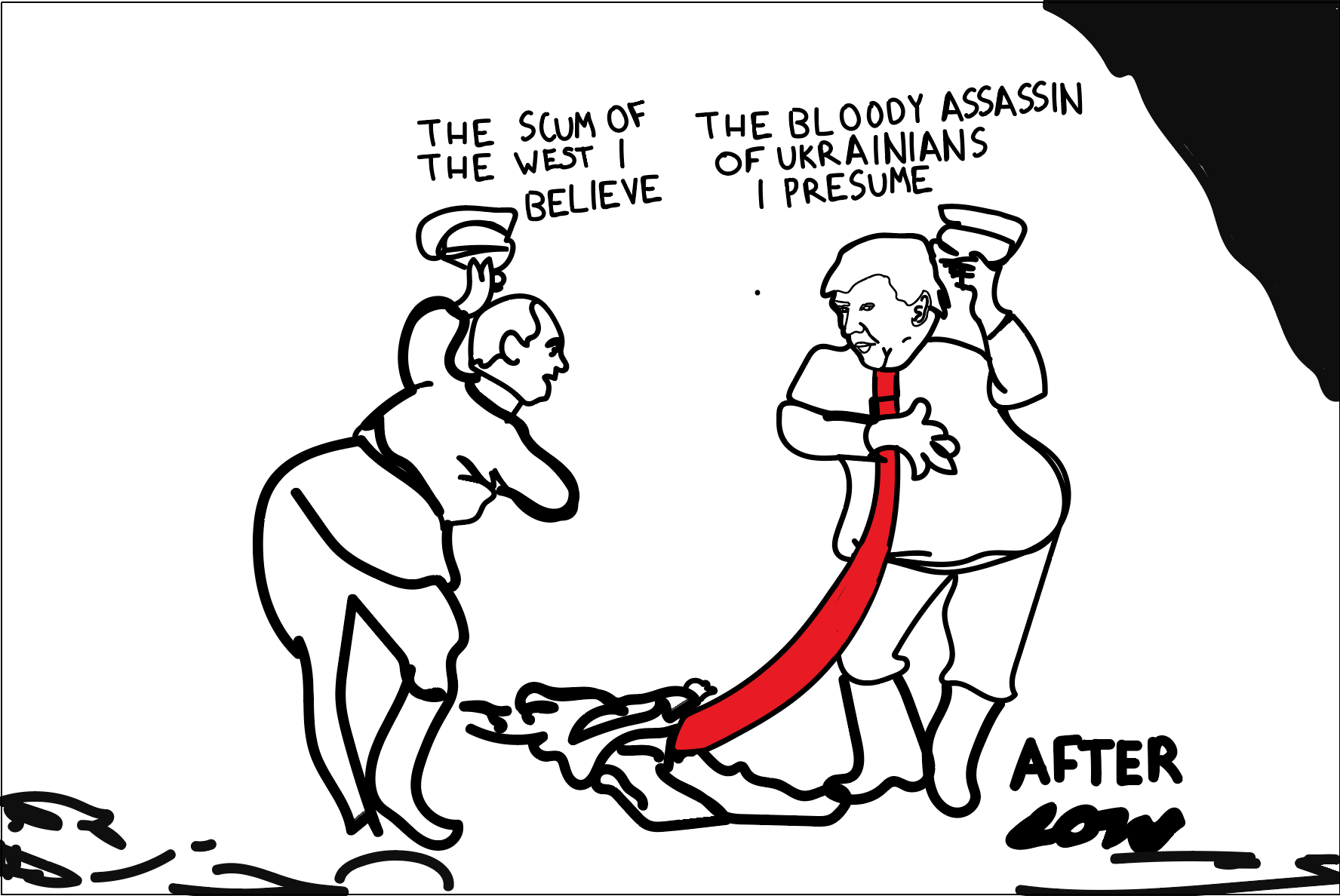
Image Credit: Eliot Lord, After David Low’s Rendezvous
WASHINGTON — The White House on Friday 17th of October hosted a genial yet measured meeting between Presidents Donald Trump and Volodymyr Zelenskyy — an encounter that signaled composure and strategy. Behind the outward civility, Trump appeared intent on turning America’s military posture — particularly the question of Tomahawk cruise missiles — into leverage aimed at compelling Vladimir Putin toward negotiation.
In tone and choreography, the meeting reflected a familiar tenet of great-power diplomacy: conciliation used not to concede, but to create space for pressure.
A Meeting of Calculation and Optics
Zelenskyy arrived in a dark jacket —
Trump paused to remark, “I think he looks beautiful in his jacket. I hope people notice. It’s actually very stylish. I like it.”
The exchange, half compliment and half signal, underscored the meeting’s balance of civility and calculation — diplomacy conducted through tone as much as through policy.
Zelenskyy later emphasized the evolving rapport:
“We begin to understand each other,” he said. “He understands what is going on in the battlefield, and it helps.”
Trump, in turn, framed the war’s resolution through his characteristic lens of transactional realism, reminding the public that no Americans are fighting and that NATO, not the United States, is financing the current flow of weapons.
“We’re not losing people, we’re not spending money… We made a very good deal with NATO.”
He added, “That’s not why, though — we’re in it to save thousands and thousands of lives.”
He went further:
“To end the war, it’s three people — the president, the president, and the president. It’s easier when they like each other. We’ll try to keep them a little apart.”
The remark distilled Trump’s approach — reducing complexity to personality and power while explicitly positioning himself as the broker.
Tomahawks as Diplomatic Currency
Pressed on whether the United States would provide Ukraine with Tomahawk cruise missiles, Trump delivered a pointed warning:
“Tomahawks are a very dangerous weapon.”
He then pivoted to U.S. national security, avoiding any suggestion that a decision had been made:
“We want Tomahawks also. We don’t want to be giving away things that protect our country.”
He added, “Hopefully, we’ll be able to get the war over without thinking about Tomahawks. I think we’re fairly close to that.”
Trump also reminded reporters of his earlier decision to authorize lethal aid to Ukraine — a subtle reinforcement of his deterrence posture:
“I gave them the Javelins. That wasn’t given by Obama. That was given by me. They’re devastating weapons.”
Together, the Tomahawk and Javelin remarks projected controlled menace — a reminder that the arsenal underpinning diplomacy remains formidable.
Then, in a remark that defined the day, Trump connected his strategy to a familiar doctrine:
“We had to set the table for peace,” he said. “I think we’re setting the table for peace in Ukraine as well.”
Trump credited strikes on Iran as helpful to peace in the Middle East, saying they had “set the table for peace” between Gaza and Israel.
Oil Leverage and Economic Pressure
Beyond missiles, Trump also sought to pressure Russia’s oil revenues. In public remarks, he claimed India would soon halt purchases of Russian crude — part of a broader effort to choke off Moscow’s wartime income.
Meanwhile, oil markets reacted. On Friday, Brent crude fell about 0.13% to $60.98 per barrel, and U.S. WTI declined roughly 0.16%, placing both benchmarks down nearly 3% for the week.
The price drop reflects reduced market anxiety over supply constraints, as traders parsed the prospect of détente with Russia. It also signals how energy leverage has returned to the strategic toolkit — undercutting Russia’s ability to sustain war financing through oil.
Trump also increased diplomatic pressure on major buyers. The United States and United Kingdom are urging India, China, and other Asian importers to reduce their Russian oil consumption starting in December.
These moves — missile diplomacy coupled with energy pressure — form a dual axis of leverage. Putin, already constrained by sanctions and facing revenue shortfalls, now faces pressure from both battlefield dynamics and balance-of-payments stress.
Budapest: A Neutral Ground With History
Trump and Putin have provisionally agreed to meet in Budapest, according to statements from both sides. The Kremlin says the summit could take place within two weeks, though the date and logistics remain under negotiation.
The choice of venue reflects a practical constraint — the two leaders do not meet in NATO countries, and with Finland now off the table since joining the Alliance, few European options remain.
Hungary has pledged to guarantee safe passage for Putin despite the outstanding International Criminal Court arrest warrant against him. Prime Minister Viktor Orbán’s government has formally notified the United Nations of its intent to withdraw from the ICC — a process that will take a year to complete — and has said it will not enforce the warrant in the meantime.
For Orbán, the summit represents a moment of political theater; for Trump, a stage to project statesmanship on neutral soil. Budapest carries symbolic weight — once a Cold War frontier, now the rare European capital able and willing to host both leaders.
The choice has stirred controversy across Europe and within NATO, where diplomats warn that meeting in an EU member state still technically bound to ICC obligations risks undermining collective legal norms. Still, the optics serve Trump’s instinct for control: narrow the field, dictate the setting, and make balance itself the message.
A Strategy of Pressure Through Poise
Trump’s “Tomahawk diplomacy” operates in the gray space between deterrence and dialogue. By invoking advanced weaponry while speaking of restraint, and pairing it with energy sanctions and market signals, he amplifies leverage without committing to escalation.
It is a high-risk, high-control maneuver — the use of latent force and financial pressure to set the table for peace. Overplayed, it could provoke confrontation; underplayed, it risks appearing hollow. Yet as doctrine, it aligns with his enduring view of statecraft: that the appearance of readiness — military and economic — is itself a tool of negotiation.
Zelenskyy, for his part, must navigate this recalibrated terrain. His tone toward Trump — appreciative yet cautious — suggests awareness that the new equilibrium is political as much as military.
The Emerging Equation
If the logic holds, Trump’s approach represents a calculated balancing act: pressure calibrated to draw the adversary to the table, conciliation offered only to sustain momentum toward talks.
Whether the Budapest summit fulfills that vision remains to be seen. For now, the choreography is clear — diplomacy conducted in public view, power negotiated through optics, and peace defined not by trust, but by timing.